

Diplomacy
"The Republic of Baüme's diplomatic efforts, backed by their dedicated armed forces, are a testament to their commitment to global cooperation and security."
- Becky Gorwell of the Independent State of Powell
The Schnaten:
The Schnaten is a formal military alliance that unites the Republic of Baüme with all of its satellite and puppet states under a centralized strategic command. Established as both a defensive and expansionist coalition, the Schnaten functions not merely as a military pact but as an instrument of political influence, ensuring that Baüme maintains strict control over its dominated territories. The alliance’s structure allows for the integration of local forces from puppet governments into a coordinated, hierarchical command, with ultimate authority residing in Baüme’s Ministry of Defense.
The term “Schnaten” is derived from the German translation of “Catholic Nationalist States”, reflecting the ideological foundation of the alliance. Its members are bound together by a shared adherence to conservative Catholic values, nationalist ideology, and the promotion of Baüme’s political and territorial interests. While nominally cooperative, the alliance operates primarily as an extension of Baüme’s authority, using military cohesion to suppress dissent, deter external threats, and project power beyond its immediate borders.

Independent State of Powell

Republic of Baüme

Caravan-Baüme Dependency
The UNSM:
Flag of the United Nations of Sovereign Micronations
The UNSM, or United Nations of Sovereign Micronations, was established in 2026 by the Second Christian Republic of Tehastan and the Republic of Baüme. It was created to provide a platform for small, self-declared nations to cooperate on matters of diplomacy and defense. The organization acts as both a peaceboard, helping members resolve disputes, and a mutual defense pact, ensuring that attacks against one member are treated as attacks against all. The alliance currently includes six member states, each retaining full sovereignty while committing to collective security. The UNSM emphasizes self-determination, cultural preservation, and the protection of micronational sovereignty. It allows members to coordinate on diplomatic initiatives, organize joint military exercises, and strengthen their international legitimacy.
By combining diplomacy with mutual defense, the UNSM provides a unique framework for cooperation among small nations. It reflects the vision of its founding members, who sought to create a formal alliance capable of supporting both the security and political recognition of its member states in a world dominated by larger powers.
Second Christian Republic of Tehastan
Bomber Republic

Republic of Baüme

Nation of Larsonia

The Republic of Cappyland and the North French State
Republic of Leatherland
WWOM:
The World Wide Organization of Micronations, or WWOM, is a unique international body dedicated to bringing together micronations from across the globe under a shared framework of respect and cooperation. Much like larger global institutions, the WWOM serves as a platform where member states can formally recognize one another, fostering legitimacy and mutual acknowledgment within the micronational community. By creating a structured environment for dialogue, the organization helps smaller or emerging nations establish their identity on an international stage. At its core, the WWOM is committed to diplomatic cooperation and the development of international norms tailored to the needs and realities of micronations. Through discussions, agreements, and collaborative initiatives, member states work together to draft and uphold laws that guide peaceful interaction, resolve disputes, and promote stability. This emphasis on diplomacy ensures that even the smallest nations have a voice, encouraging constructive engagement rather than isolation.
Importantly, the WWOM distinguishes itself by focusing solely on diplomatic and legal collaboration, without extending into military, economic, or defense alliances. This deliberate limitation reinforces its mission as a peaceful and neutral forum, where cooperation is built on dialogue rather than power. In doing so, the organization embodies a vision of international unity grounded in respect, recognition, and the shared pursuit of orderly global interaction among micronations.
Second Christian Republic of Tehastan

Republic of Baüme
Bomber Republic

Nation of Larsonia

United Territory of Siwel

United Republic of Lanyland
Smiths Alliance:
The Smiths Alliance is a symbolic agreement between the Republic of Baüme and Rhodesial, established solely to recognize Rhodesia's historical existence as a friendly political entity. This alliance exists purely to acknowledge the period between 1965 and 1979 when Rhodesia functioned as a de facto government in southern Africa. The Republic of Baüme affirms that this recognition is historical and symbolic, and does not imply support for any policies, governance systems, or ideologies associated with Rhodesia. Through the Smiths Alliance, the Republic of Baüme formally documents its acknowledgment of Rhodesia in its records, ensuring that this historical state is remembered as part of the region’s political history. The alliance is limited in scope and effect, applying solely to Rhodesia and carrying no legal, territorial, or diplomatic claims. It reflects the Republic of Baüme’s interest in historical recognition and its commitment to accurately recording the existence of former political entities, while rejecting the modern state of Zimbabwe as the legitimate successor in the territory formerly known as Rhodesia.

Republic of Baüme
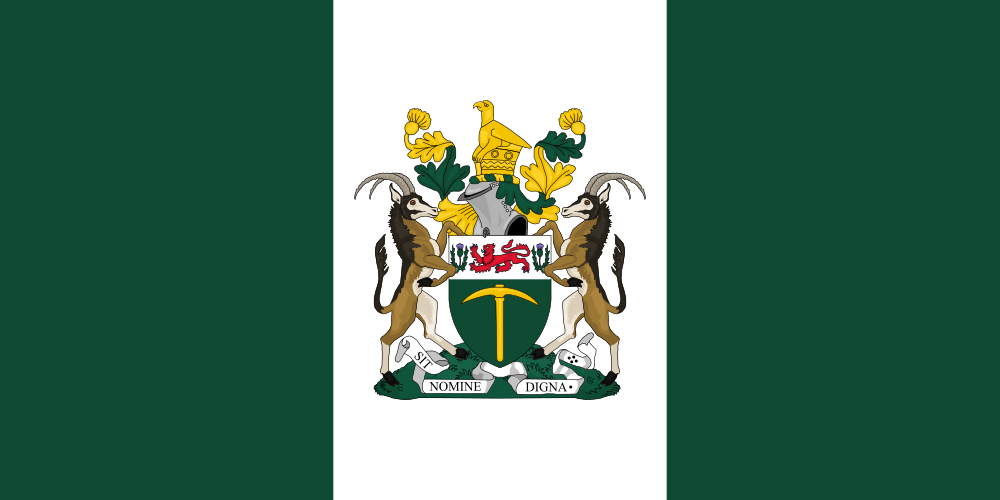
Republic of Rhodesia
Create Your Own Website With Webador